A gap is the market telling you something happened while you weren't watching. Between yesterday's close and today's open, news broke, an order imbalance built up, or nothing meaningful occurred at all and a handful of pre-market trades on thin volume just printed at a different price. The size of the gap tells you almost nothing about which of those it was. The cause tells you everything, and it's the one piece of information most gap-trading advice skips in favor of a rule about percentages.
Same gap, opposite trades
The entire decision — fade it back toward yesterday's close, or follow it in the direction it opened — turns on what's behind the print, not on how far it moved.
What caused the gap changes what it means
| Cause | Typical behaviour | Lean |
|---|---|---|
| Earnings beat or raised guidance | Often holds or extends once the market has priced the new information in | Follow, with confirmation |
| Earnings miss or cut guidance | Often holds or extends lower for the same reason, just in the other direction | Follow, with confirmation |
| Single analyst up/downgrade, no other news | Frequently fades as the initial reaction unwinds through the morning | Fade candidate |
| Sector- or index-wide move, stock has no news of its own | Tends to trade with the group rather than on its own logic | Watch the sector, not just the stock |
| Thin pre-market print, low volume, no identifiable catalyst | Often round-trips back toward the prior close once regular volume arrives | Fade candidate |
| M&A, regulatory action, halt-and-reopen | Repriced to a new level; the old range may not be relevant anymore | Neither — this is a different stock now |
Notice what's missing from that table: a percentage. A 4% gap on an earnings beat and a 4% gap on a single upgrade from an analyst nobody follows are not the same trade, even though a scanner sorted by gap size would put them next to each other. The scanner sees magnitude. You need cause.
Finding the cause is usually a two-minute job, not a research project. Check the company's own news first — an earnings release, a filing, an FDA decision, a guidance update. If there's nothing there, check whether the whole sector or a major index future is moving; a stock can gap on no news of its own simply because everything in its group is repricing overnight. If neither turns anything up, you're likely looking at a thin, low-conviction print, and the lean in the table above should carry more weight than it would if you'd found a real catalyst. The order matters: company-specific news beats sector-wide moves, and both beat "no identifiable reason," which is itself useful information.
Fill and continuation are the only two outcomes, and they look different by the open
Once you know roughly what's driving the gap, the practical question is which of two things happens next: the gap closes, or it doesn't. Reading how the first stretch of trading behaves is how you find out before it's obvious.
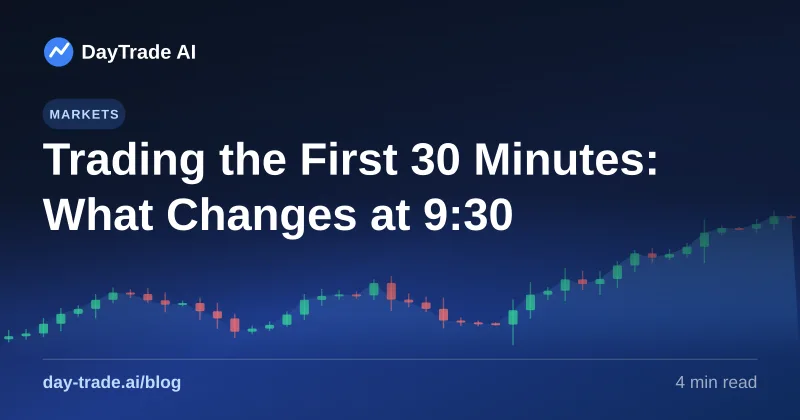
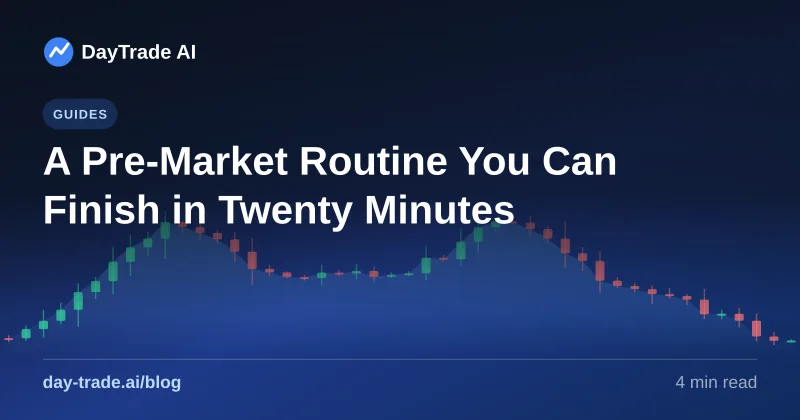
Both charts above start from the same kind of gap. What separates them isn't visible at 9:30 — it shows up in whether the opening range holds. That's the same logic that applies to trading the first 30 minutes generally: the opening print is provisional, and the range that forms in the minutes after it is what actually tells you something. A gap doesn't get a pass on that just because it happened overnight instead of at the bell.
Volume is the tiebreaker when the price action alone is ambiguous. A gap that holds its opening range on volume climbing above the stock's recent average is a different signal from one holding on volume that's already fading — the first looks like fresh participants agreeing with the move, the second looks like the initial print running out of buyers or sellers before it's gone anywhere. If you only have time to check one number before deciding whether a gap is filling or continuing, check whether volume in the first few minutes is expanding or contracting relative to the open.
What to check before the range even forms
Most of the useful work happens before you place anything, in the pre-market and the first few minutes. This is where a pre-market routine earns its keep on a gap day specifically — you want these questions answered before 9:30, not during it.
Before you trade a gap
-
Identify the specific cause — News, a filing, a sector move, or nothing you can point to. If you can't name it in one sentence, you don't have an edge on this one yet.
-
Size the gap against the stock's own range — Compare it to the average daily range for this ticker, not to a round percentage that means nothing for a specific stock.
-
Check pre-market volume against its average — A large gap on unusually light volume is a thinner, less reliable signal than the same gap on heavy participation.
-
Wait for an opening range to form — A few minutes of trading after 9:30 tells you whether the gap is holding or already unwinding. The first print by itself doesn't.
-
Know your invalidation before entry — For a fade, that's usually a new high beyond the opening print. For a continuation, it's usually a close back through the opening range.
-
Trade every gap the same way regardless of cause — Treating a thin, newsless print and an earnings beat as the same setup because they're the same size on the scanner.
The last item is the mistake this whole approach is built to prevent. A gap scanner is a magnitude filter, not a strategy. It's a useful way to find candidates and a bad way to decide what to do with them.
The bias to watch for in yourself
There's a specific trap in gap trading that's worth naming directly, because it's easy to fall into even after you know the cause matters.
This matters most on the gaps that look the most dramatic, because a big print is exactly when the temptation to skip the checklist is strongest. A 6% gap feels like it demands immediate action. It doesn't demand anything except identifying why it happened, which takes the same few minutes whether the gap is 1% or 10%.
Sizing the trade once you have a lean
Once you've identified the cause, sized the gap against the stock's normal range, and watched the opening range hold or fail, the actual trade decision is closer to any other setup than it might feel in the moment. A fade against a gap that's already showing weakness in its first few minutes is a normal mean-reversion trade with a level (the opening print) to stop against. A continuation trade off a gap that's holding on volume is a normal breakout trade with the opening range low as your invalidation. Neither one needs a special "gap trading" rulebook once you're past the identification stage — they need the same discipline any other setup does: a defined entry, a specific level that proves you wrong, and a size that reflects the distance between them.
What does need to happen before that stage is the part most gap-trading content shortcuts: naming the cause, checking the gap against the stock's own behavior, and letting the open actually open before treating any single print as a level worth trading against. Do that consistently and the gap stops being a special, adrenaline-loaded event and becomes what it actually is — one more piece of information the market handed you, which you now have to read the same way you'd read anything else on the chart.